Trade Review and Tips for Trading the British Pound
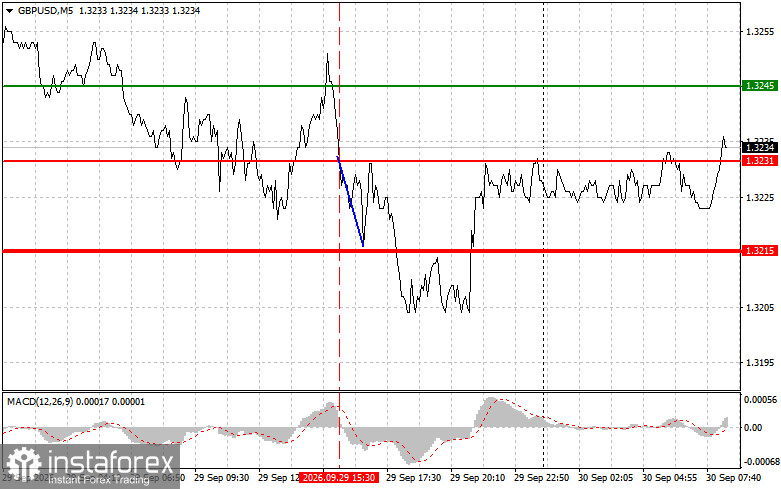
The price test at 1.3231 occurred as the MACD indicator began moving down from the zero line, confirming a correct entry point to sell the pound. As a result, the pair fell toward 1.3215.
Weak US consumer-confidence data flipped the day for GBP/USD. The consumer-sentiment index plunged to 81.9 in September, down 6.7 points, and that proved to be the trigger that left pound buyers without the momentum to take active positions. The dollar retreated broadly, and the pound took advantage of the space. The essence is this: when US consumers grow more pessimistic about incomes and the jobs market while inflation expectations rise to 6.1%, the Federal Reserve faces a painful dilemma. Tight policy amid weakening demand risks accelerating an economic slowdown, and the market understands this and begins to price a softer Fed scenario.
This morning is one of the week's key moments for the pound. The UK publishes the final Q2 GDP estimate, investment figures and the current-account balance, and this package will set the tone for GBP/USD trading for the next few hours. Final GDP figures formally confirm preliminary estimates, but the market often reacts to even small deviations—especially when the pound is already balancing at a fork in the road after several days of mixed signals. Investment data and the current-account balance will add important context. Sustained growth in investment suggests business confidence in the UK economy's prospects despite high Bank of England rates, while the current account reflects the external balance and capital flows. If final GDP comes in above the preliminary estimate and investment shows positive momentum, the combined effect could be quite supportive for the pound, as it would strengthen policymakers' hand in easing policy. Otherwise, the picture changes sharply: disappointing numbers would provide a reason for a new wave of GBP/USD selling, especially since the pair remains vulnerable to negative surprises after recent mixed credit data.
In my view, today's data have real potential to move the market either way, so it's important to monitor them in real time.
For intraday strategy, I will mainly rely on executing Scenarios No. 1 and No. 2.
Buy Scenarios
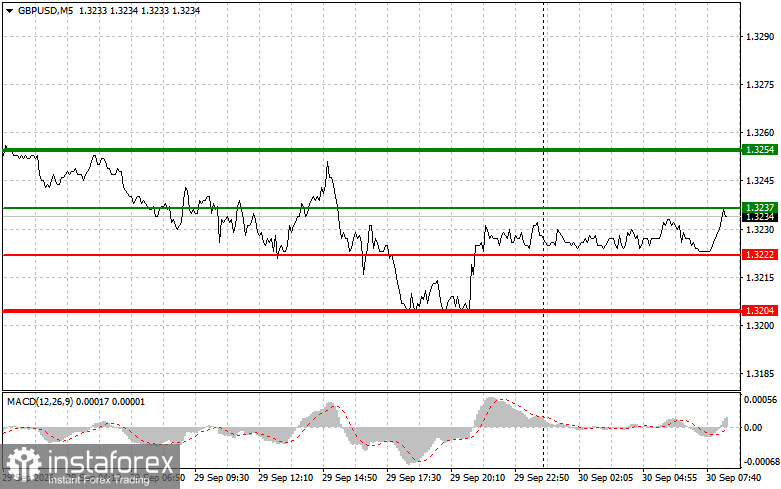
No 1: I plan to buy the pound today around 1.3237 (green line on the chart) with a target of 1.3254 (thicker green line on the chart). Around 1.3254, I plan to exit long positions and open short positions in the opposite direction (expecting a 30–35 pip counter-move). Expect pound gains today only after good data. Important: before buying, ensure the MACD is above zero and has just begun to rise.
No 2: I also plan to buy the pound if the price tests 1.3222 twice in a row while MACD is in the oversold area. This would limit the pair's downside potential and trigger an upward reversal. Expect moves to 1.3237 and 1.3254.
Sell Scenarios
No 1: I plan to sell the pound after the 1.3222 level is broken (red line on the chart), which should lead to a rapid decline. The sellers' key target will be 1.3204, where I plan to exit shorts and immediately open longs in the opposite direction (expecting a 20–25 pip counter-move). Bad news will put pressure back on the pound. Important: before selling, ensure the MACD is below zero and has just begun falling.
No 2: I also plan to sell the pound if the price tests 1.3237 twice in a row while MACD is in the overbought area. This would limit upside potential and trigger a reversal downward. Expect declines toward 1.3222 and 1.3204.
What to Look for on the Chart:
- Thin Green Line – Entry price at which you can buy the trading instrument;
- Thick Green Line – Estimated price where you can set Take Profit or manually secure profits, as further growth above this level is unlikely;
- Thin Red Line – Entry price at which you can sell the trading instrument;
- Thick Red Line – Estimated price where you can set Take Profit or manually secure profits, as further decline below this level is unlikely;
- MACD Indicator. When entering the market, it's important to consider overbought and oversold zones.
Important: Beginner traders in the Forex market need to be very cautious when making entry decisions. It is best to stay out of the market ahead of significant fundamental reports to avoid being caught in sharp price fluctuations. If you decide to trade during news releases, always set stop orders to minimize losses. Without stop orders, you can quickly lose your entire deposit, especially if you do not employ money management practices and trade large volumes.
Also, remember that successful trading requires a clear trading plan, similar to the one provided above. Making spontaneous trading decisions based on current market conditions is inherently a losing strategy for intraday traders.