The euro continued to decline versus the dollar, repeating recent days' dynamics even though there are noticeably fewer fresh reasons for it. Comments by European policymakers this week raise questions: on one hand, inflation creates obvious difficulties, but on the other hand, much of it so far comes from rising energy prices and already-taken rate decisions, with no clear signs of second-round effects. According to Lagarde, the rate increases already discussed may be sufficient to prevent inflationary pressures from spreading to the broader economy. The emphasis remains on energy prices, which rise with oil, and both European politicians and economists point to the Middle East situation as the main trigger for further price increases. Taken together, this works against the euro and in favor of the dollar.
No eurozone data were released yesterday, so the euro had no formal reason to rise in the first half of the day. More attention went to US data, and the winner there was not the dollar but growing uncertainty: JOLTS job openings (per the Bureau of Labor Statistics) were essentially unchanged from July, while the consumer-confidence index plunged from 88.6 in August to 81.9 in September. That is a significant drop, and it matters not only numerically: a notable share of respondents now expect a recession within the next 12 months, and inflation expectations jumped to 6.1%. The paradox is that consumers are cutting spending amid recession fears while inflation accelerates not because of demand but because of energy prices—something higher consumer savings cannot address.
That puts the Federal Reserve in a difficult position: on one hand, it must raise rates to fight inflation; on the other, the first signs of economic slowing are already visible. I do not yet see an imminent threat, but the trend should not be ignored: if weakness reaches the labor market, further Fed hikes will be called into question. The market reacted to weak consumer confidence and economic risks by pushing the dollar down against the euro and the pound, so yesterday's data weakened the dollar more than today's price action may suggest at first glance.
For the pound, yesterday's mortgage data showed approvals at 54.9k, well below economists' forecasts and slightly lower than August. However, net lending to individuals jumped to 6.9% from 6.2% in August, and one indicator effectively offset the other. That is why the pound did not suffer seriously from that release; after hitting a weekly low and seeing weak US data, it recovered fairly strongly and has shown greater resilience than the euro for the second day in a row.
Today the market will focus on a much larger set of figures. For the UK, the final Q2 GDP estimate is due: the consensus expects growth of 0.6% quarter-on-quarter (same as Q1) and 1.2% year-on-year. Because this is the final reading, the pound will likely ignore it in the absence of revisions, but the risk of a downward revision against the backdrop of the Middle East situation could prompt selling. Investment change data (forecast +1.7%) and the current-account balance are also due, so the combined statistical flow could move the pound noticeably in either direction.
For the eurozone, the main focus will be German retail sales: after a sharp 3.4% drop in July, a 1.4% increase is expected in August, and such a recovery could support the euro. Germany's unemployment rate is forecast unchanged at 6.4%, while German CPI looks far more important: headline inflation is expected to accelerate to 0.5% in September from 0.2% in August. A beat would signal to markets that the recent European Central Bank rate hike was justified, increasing the chances of further tightening — a direct positive for the euro.
US data today are no less packed. The final Q2 GDP estimate is expected at 1.5% (no revision), reflecting a notable slowdown from 2.1% in Q1; a downside revision would add pressure to the dollar ahead of key labour reports. ADP employment is forecast at 70k after just 38k in August: the series has been declining since May, so the expected jump would likely be read as a positive for the dollar. Core PCE is forecast at 0.3% for August versus 0.2% in July, or about 3.4% year-on-year, and a print above expectations would give the Fed an additional argument that inflationary pressure is not abating but rising. That would directly affect the probability of a rate hike at the next meeting — currently priced at roughly 40% — so today's inflation and employment prints carry elevated importance despite the crowded schedule of Fed speakers.
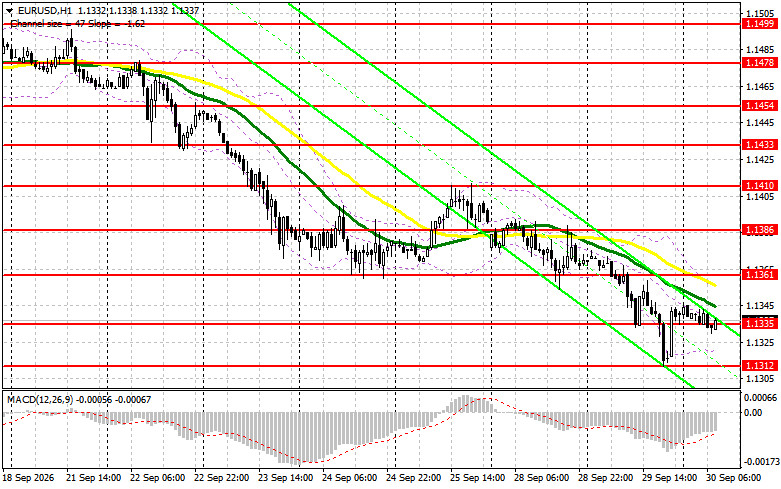
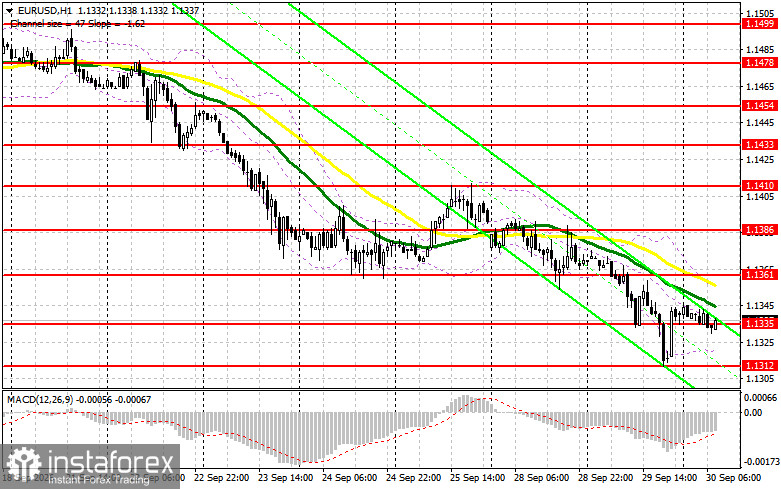
EUR/USD — on the hourly chart, I watch 1.1335 for long positions: a false break there opens a rise to 1.1361, and a close above that range gives a chance to move to 1.1386, where I would look to sell on a bounce for 20–25 pips. Short positions from 1.1361 work only after a failed upside breakout; moving averages and the recent downtrend reinforce this idea. A false break of 1.1335 followed by a return below the level is a reason to add shorts toward 1.1312, and a break of that range opens the way to 1.1288 and 1.1249, where I would consider buying a bounce for a 15–20 pip correction. Longs from 1.1312 and 1.1288 are valid only on a false downside breakout.
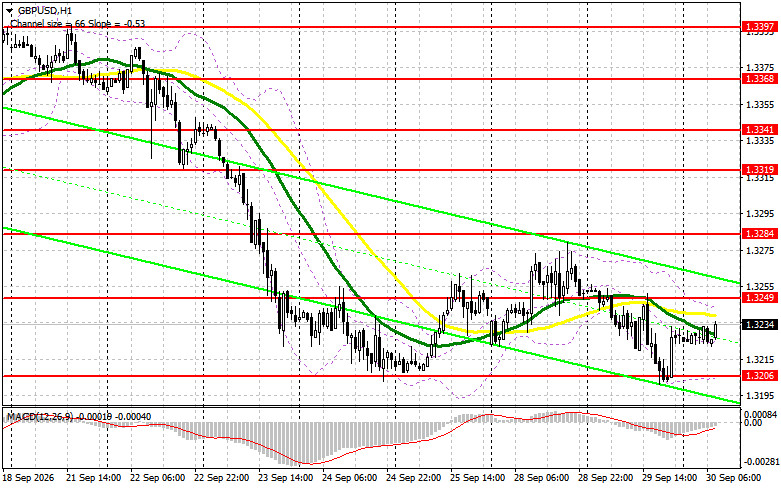
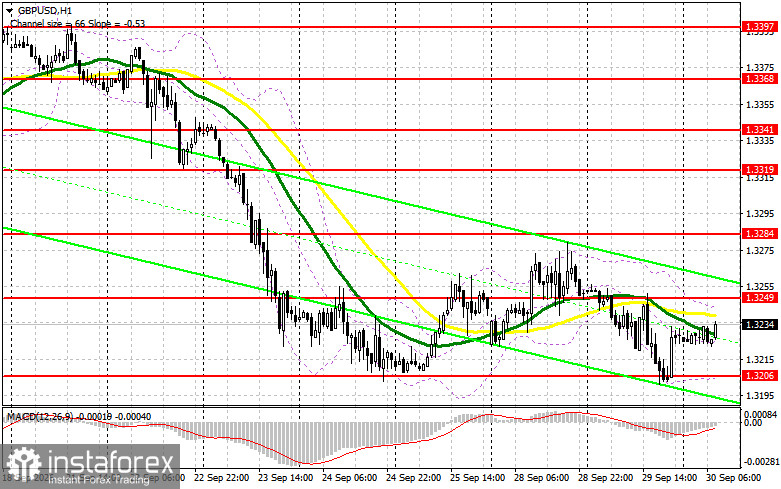
GBP/USD — the picture is similar: support at 1.3206 held yesterday and provided a good long entry, and today the pound will react to UK GDP data, so 1.3249 is in focus. If the market receives no big surprises, a false break of that level would be a sell trigger toward 1.3206, while a close below the range would open the path to 1.3173 and 1.3137, where I'd look to buy a rebound for 20–25 pips; longs from 1.3173 and 1.3206 apply only on a false breakout. If bulls take 1.3249, skip shorts until 1.3284 on a failed close, or consider selling a bounce from 1.3319 with the same 20–25 pip target.
In short, weak US consumer confidence and early signs of economic slowing create more difficulties for the Fed than the euro can immediately exploit. Until the eurozone confirms ECB readiness for further tightening with its own inflation and retail data, the dollar's weakness is likely to be episodic rather than structural. I expect today's data block — especially German CPI and US PCE — to determine whether the dollar resumes strength versus the euro and the pound by the end of the week.